Models
Routing picks which model does the work for a lane or its subagents. There are two separate levers. Lever A is always on and stays on your own Claude login. Lever B is optional, needs your own API key, and is off by default — a setting you turn on yourself in Settings → Models.
Agents panel
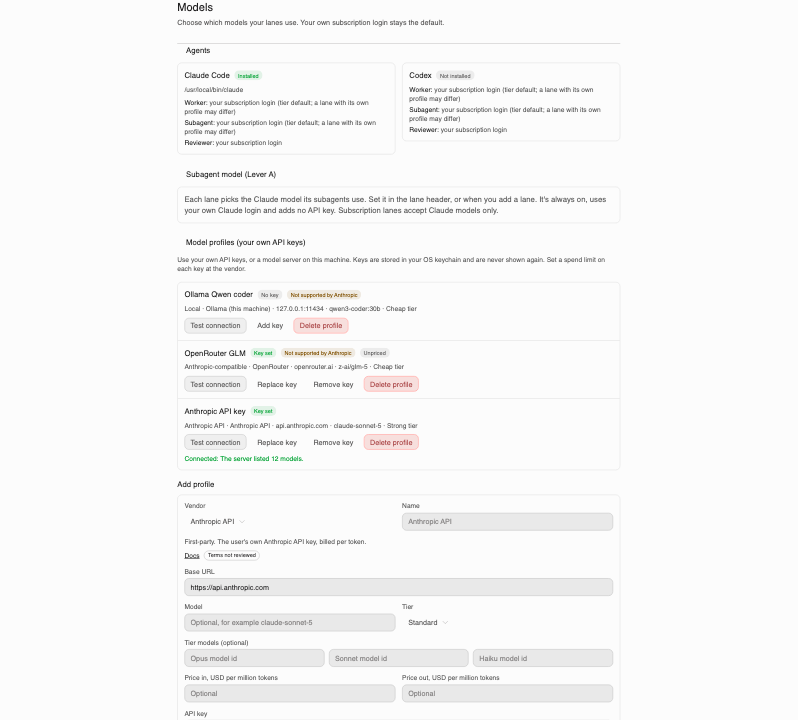
The top of Settings → Models is a read-only “Agents” panel: for each CLI (Claude Code, Codex), whether it’s installed and where, and for each role (worker, subagent, reviewer) which auth mode it would run under right now — your subscription, a named API-key profile and its tier, or blocked with a reason. Worker and subagent are the tier default a lane gets when it names no profile of its own; reviewer is exact, since there’s one pin rather than a per-lane choice. There is no control here, only visibility: it spawns nothing new and reads no credential file.
Lever A: subagent model
Every lane has a subagent model. It sets CLAUDE_CODE_SUBAGENT_MODEL for the lane’s claude
process, which picks the model every subagent, agent team and workflow agent in that lane uses.
- It stays on your own Claude login. No gateway, no API key, no base URL.
- Only Claude models are allowed:
inherit,haiku,sonnet,opus,fable, or a fullclaude-*model id. A non-Claude id is refused. inheritsets nothing. Each subagent then uses its own frontmatter model, or the lane’s main model.- A lane can set its own subagent model, or leave it to the pack role’s default. The lane’s own choice wins.
- It applies the next time the lane starts, not to a session already running.
- Codex has no equivalent setting. Codex lanes show no subagent-model control.
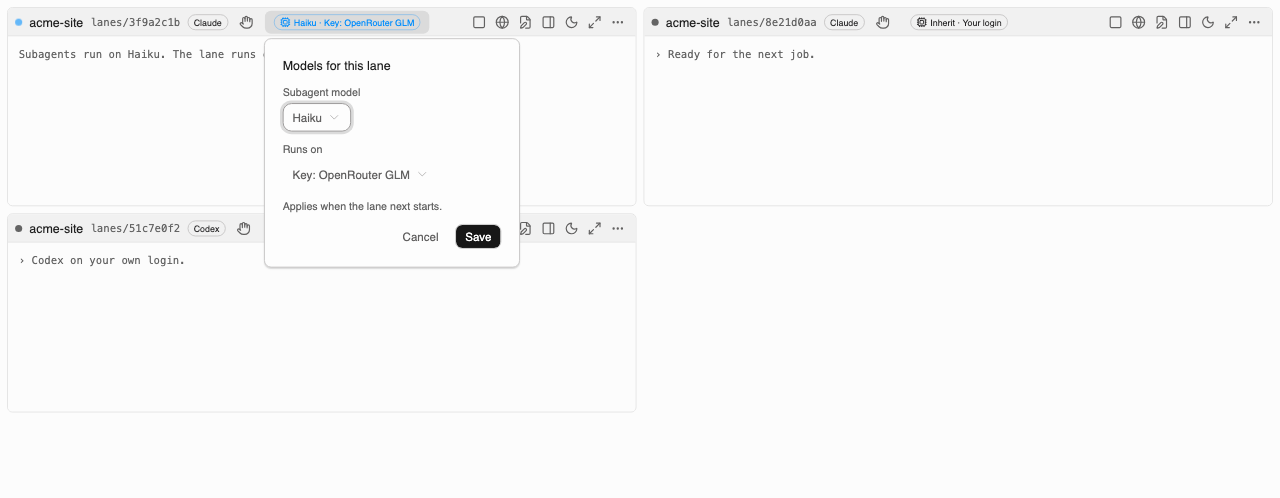
Set it in the lane header’s model badge, or when you add a lane.
Lever B: model profiles (Settings → Models)
Lever B lets a lane run on your own API key instead of your subscription login. It ships in every build, but stays off by default: a “Model profiles” toggle in Settings → Models, next to a warning that turning it on bills real API calls to you. Turning it on by itself changes nothing — every lane and reviewer still runs on your subscription until you also add a profile and point a lane at it. Turn it off again at any point and every profile is ignored again, immediately, even one still configured on a lane.

Profile kinds
A profile has a kind, which decides how Ninebrains talks to it:
| Kind | What it is |
|---|---|
anthropic-api | Anthropic’s own API, with your key |
openai-api | OpenAI’s own API, with your key, for Codex |
anthropic-compatible | A vendor that speaks Claude Code’s /v1/messages protocol |
openai-responses-compatible | A vendor that speaks Codex’s /v1/responses protocol |
local | A model server on this machine, either protocol |
bedrock, vertex and foundry are not in this version.
The vendor list
A profile’s base URL must be on Ninebrains’ reviewed vendor list, or be a loopback address for a local profile. The current list: Anthropic and OpenAI as first-party APIs, OpenRouter and Fireworks as reviewed remote vendors, and Ollama and LM Studio as local presets. Any other host is refused when you save the profile.
Keys stay write-only
You paste a key once. Ninebrains stores it in your OS keychain as ninebrains.model.<id> and never
shows it again, not even to you. The Settings page can set, replace, test and delete a key, never
read one back.
Test connection
The Test connection button makes one GET request for the vendor’s model list, using your key. It does not run a model, and it does not follow redirects: if the vendor redirects, use the final URL as your base URL instead.
Choosing a profile for a lane
The lane header’s “Runs on” control (and the same field on the add-lane form) lists “Your subscription” plus every enabled profile that matches the lane’s agent (Claude profiles for Claude lanes, Codex profiles for Codex lanes).
What each gets:
- A Claude lane on a profile gets
ANTHROPIC_BASE_URL, an auth token or key, and the profile’s model mapped onto theANTHROPIC_DEFAULT_*_MODELaliases. - A Codex lane on a profile gets a
nbmodel provider added to its launch (base_url,wire_api=responses), with the key passed in theNB_MODEL_KEYenvironment variable.
Profile routing applies to attended lanes and to unattended runs alike.
“Not supported by Anthropic”
Anthropic’s own words: it doesn’t support routing Claude Code to non-Claude models through any
gateway. When a Claude-protocol profile points at a host other than api.anthropic.com, Ninebrains
shows a “Not supported by Anthropic” badge. The profile can still work, but Anthropic doesn’t
maintain or audit it, and some features may not work.
Reviewer model (optional pin)
By default, every reviewer run — the reviewer and security-review gates — stays on your
subscription, whichever agent did the work. Settings → Models has a Reviewer model picker, next
to the profile list, that lets you pin reviewers to one model profile instead.
Once you pin a reviewer profile, it is never silently downgraded (SEC-42): if the pinned profile is missing, disabled, has no key, or is unhealthy, the review is blocked, not passed and not retried on your subscription or a cheaper tier. Clear the picker to go back to the subscription default.
The picker appears once you have at least one profile, whether or not the Model profiles toggle is on. While that toggle is off, though, any pin sits there unused: it’s read live on every review, and folds to “no pin” until you turn the toggle on, so reviewers keep running on the subscription until you do.
SEC-39, in plain words
A lane on your subscription never gets a gateway URL, token or key. Ninebrains blanks
ANTHROPIC_BASE_URL, ANTHROPIC_AUTH_TOKEN and ANTHROPIC_API_KEY for that launch, even if your
shell or your own Claude settings files set them. The one exception is the subagent model, which
must still be a Claude model.
If enterprise-managed Claude settings set a gateway variable, Ninebrains refuses to launch instead of guessing. Managed settings outrank everything Ninebrains writes, so there’s no safe way to override them.
The run-start check (SEC-41)
For unattended Claude runs, Ninebrains reads the CLI’s own report of which credential and which model it’s using, at the start of the run. If that doesn’t match what the lane should be running on, the run is stopped immediately, before it does any work.
There’s a wrinkle: a gateway token (ANTHROPIC_AUTH_TOKEN) reports the same credential source as a
subscription login. Ninebrains can’t tell them apart from that field alone, so the model in use
does that part of the check instead.
Codex has no equivalent signal in its run output. The provider it used can only be read after the fact, from its session file.
Your key lives in the lane’s environment
A profile’s key sits in the environment of the process it launches. That means any tool the lane’s agent runs — a shell command, for example — can read it. This is an accepted risk (R19). Set a spend limit on every key at the vendor, so a leaked or misused key has a ceiling.
Not in this version
These are wave 2 work, not built yet:
- Costs and budgets in dollars.
- Fallback to another model or vendor when one fails.
Troubleshooting
| Message | What it means |
|---|---|
| “profile has no API key” | Add a key in Settings → Models before using this profile. |
| “not on the vendor list” | The base URL’s host isn’t reviewed. Pick a listed vendor, or a loopback address for a local server. |
| “managed settings set ANTHROPIC_BASE_URL” | Enterprise-managed Claude settings already point at a gateway. Ninebrains won’t launch until that’s removed, since managed settings outrank the app. |
| “a subscription lane’s subagents must use a Claude model” | The lane is on your login, so its subagent model must be inherit, a tier alias, or a claude-* id. |
| A run ends on “credential mismatch” | The run-start check (SEC-41) saw a different credential or model than expected, and stopped the run before it did any work. |